





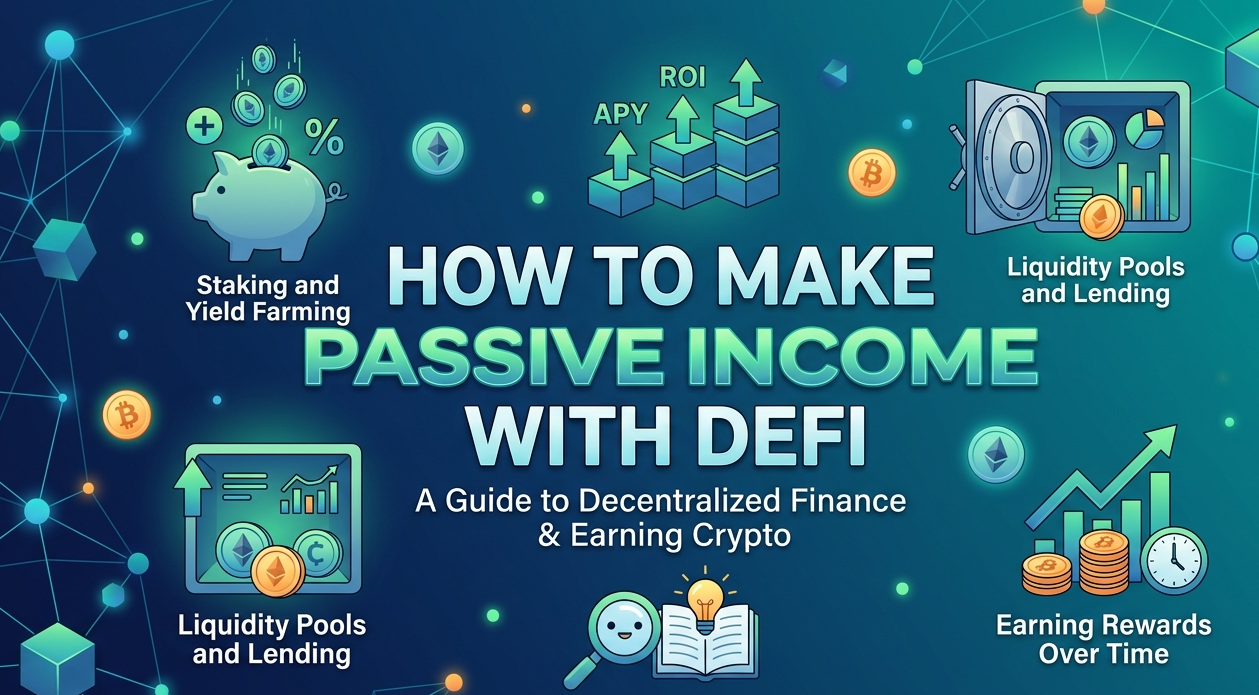
Introduction to DeFi and Passive Income
Decentralized Finance (DeFi) represents a transformative approach to financial systems that operates without central governing authorities. It leverages blockchain technology to provide various financial services such as lending, borrowing, trading, and asset management. Unlike traditional finance, which relies on intermediaries like banks and brokers, DeFi applications are built on smart contracts, enabling users to interact directly with each other. This decentralization promotes greater transparency, reduces costs, and enhances accessibility for users worldwide.
Passive income is a financial term that refers to earnings generated with minimal effort or active involvement. It allows individuals to earn money without continuous work or direct management of their investments. Common avenues for passive income include rental income from real estate, dividends from stocks, and interest from savings accounts or bonds. In the realm of wealth generation, passive income plays a crucial role, as it provides a way to accumulate wealth over time, often contributing to financial independence.
Integrating DeFi into the pursuit of passive income offers a unique opportunity for individuals to maximize their earnings in a decentralized ecosystem. Through various DeFi platforms, users can lend their crypto assets to earn interest, participate in liquidity pools, or stake tokens to receive rewards. These processes facilitate passive income generation, allowing individuals to make their digital assets work for them while minimizing time invested in active management. Furthermore, DeFi holds the potential for higher yields compared to traditional financial systems, making it a compelling choice for those seeking to enhance their financial portfolios.
Understanding the Risks of DeFi Investments
Investing in Decentralized Finance (DeFi) presents unique opportunities for passive income, yet it is accompanied by several risks that potential investors must understand. One of the primary concerns is market volatility. DeFi markets can experience significant fluctuations in asset prices due to speculation, market sentiment, and other external factors. Such volatility can lead to substantial gains, but equally to considerable losses, making it critical for investors to stay informed about market trends.
Another important risk in DeFi investments is the vulnerability of smart contracts. These self-executing contracts underpinning DeFi platforms can harbor coding errors or security flaws, which can be exploited by malicious actors. Indeed, there have been several documented incidents of hacks resulting in substantial financial losses. Therefore, thorough research into the smart contracts and the protocols used by different DeFi projects is essential to mitigate these risks.
Additionally, the regulatory environment surrounding DeFi is still evolving. Many jurisdictions are yet to establish clear guidelines governing the use of cryptocurrencies and DeFi products. Regulatory uncertainty can impact the operational viability of DeFi platforms, potentially leading to abrupt changes in the market landscape. Investors should be aware of how existing and future regulations might affect their investments.
To successfully navigate these risks, it is vital to implement effective risk management strategies while pursuing passive income strategies in DeFi. This could involve diversifying investments across different platforms, using reliable platforms with established security records, and setting clear investment parameters to limit potential losses. By combining informed decision-making with prudent risk management, investors can work towards maximizing their potential returns while minimizing adverse outcomes in the volatile DeFi space.
Popular DeFi Income Streams
The Decentralized Finance (DeFi) landscape offers numerous avenues for generating passive income, each catering to different risk appetites and investment strategies. The primary methods include yield farming, liquidity provision, staking, lending, and borrowing.
Yield Farming is a popular strategy where users allocate their cryptocurrency to various DeFi protocols to earn returns, often in the form of additional tokens. This method can result in high potential returns, but it also carries greater risks due to fluctuations in the underlying assets and the impermanent loss resulting from liquidity shifts.
Liquidity Provision involves supplying tokens to a liquidity pool, facilitating trading on decentralized exchanges. In return for providing liquidity, users earn transaction fees and often additional rewards in the form of governance tokens. The income potential depends on the trading volume within the pool and the type of tokens being provided.
Staking is another common way to earn passive income in DeFi. This process requires users to lock up their tokens in a network to support operations like validating transactions or securing the network. In exchange for staking their tokens, users receive rewards, typically in the same token or a related one. The potential returns vary based on the specific blockchain’s staking mechanism and the overall supply and demand for the token.
Lending allows users to lend their cryptocurrencies to others in exchange for earning interest. DeFi lending platforms operate on smart contracts, ensuring fair execution of the loan agreement. The interest rates can fluctuate based on market demand, providing varying passive income sources.
Lastly, Borrowing can also yield passive income indirectly. Users can borrow assets against their collateral, allowing them to maintain exposure to their original investments while utilizing funds for additional investments. Each method offers unique benefits and risks, making them suitable for different investors within the DeFi space.
How Yield Farming Works
Yield farming is a popular strategy in decentralized finance (DeFi) that allows users to earn rewards on their crypto assets by providing liquidity to various platforms. At its core, yield farming involves depositing cryptocurrency into a liquidity pool, which is essentially a smart contract that facilitates trading by enabling users to buy and sell assets without traditional exchanges. In return for providing liquidity, users are compensated with interest or rewards, often in the form of additional tokens.
The mechanics behind yield farming rely on several fundamental principles, primarily the concept of liquidity pools. These pools collect assets from multiple users and are utilized by various DeFi applications for trading, lending, and borrowing. When a trader engages in a transaction, the liquidity pool ensures that there is sufficient cryptocurrency available, thus enhancing the efficiency of the transaction.
Incentivization plays a key role in the yield farming ecosystem. Liquidity providers typically earn a portion of the transaction fees generated by the liquidity pool. Additionally, many platforms offer governance tokens or native tokens as additional rewards, further encouraging users to contribute their assets. The potential returns can be lucrative, especially in highly active markets; however, the volatility of the crypto space should be considered when evaluating potential yield farming strategies.
Several platforms have gained traction in the yield farming arena. For instance, Uniswap, a decentralized exchange, allows users to swap various tokens while simultaneously earning fees by supplying liquidity. Likewise, Aave and Compound focus on lending and borrowing protocols that also reward users for providing liquidity. Overall, yield farming extends beyond simply earning passive income; it represents a dynamic way to engage with the evolving landscape of DeFi.
Staking Cryptocurrencies for Passive Income
Staking cryptocurrencies has surfaced as a viable method for generating passive income, particularly within the decentralized finance (DeFi) ecosystem. At its core, staking involves participating in a proof-of-stake (PoS) blockchain network by locking up a certain quantity of cryptocurrency for a specified period. In return, participants receive rewards, generally in the form of additional tokens, which can accumulate over time, thereby creating a steady stream of passive income.
There are several types of staking available, allowing investors to choose options that best suit their financial goals and risk tolerance. Some of the most prominent forms include solo staking, where investors set up their own nodes to validate transactions, and pooled staking, where individuals combine their resources into a larger pool managed by a third party. Additionally, centralized exchanges often offer simplified staking services, allowing users to earn rewards without requiring extensive technical understanding, although this may introduce risks related to trust and security.
The advantages of staking cryptocurrencies are noteworthy. Passive income generated through staking is often considered more reliable compared to other investment methods, assuming the staked assets appreciate over time. Moreover, staking contributes to network security and performance, enabling participants to feel actively involved in supporting the blockchain ecosystem. However, it also has its drawbacks. Staking typically involves locking up funds for a specified duration, which could lead to liquidity challenges. Furthermore, participants must carefully assess the associated risks, particularly the effects of market volatility on their staked assets.
In conclusion, staking represents a compelling opportunity to earn passive income in the cryptocurrency space, but potential investors should conduct thorough research to understand the nuances and risks associated with different staking strategies.
Choosing the Right DeFi Platforms
In the rapidly evolving landscape of decentralized finance (DeFi), selecting the right platform for passive income generation is crucial to achieving sustainable returns. The selection process involves several key factors that potential users should consider carefully.
First and foremost, security is paramount. Users must research the security measures each platform has in place, such as auditing practices, the track record of vulnerability management, and the implementation of risk mitigation strategies. Platforms that have undergone external security audits by reputable firms are typically more trustworthy. Moreover, understanding the underlying smart contracts is essential, as these contracts govern the operations within the DeFi ecosystem. A solid grasp of these elements helps users safeguard their investments against potential threats.
The user interface is another significant factor. The DeFi platform should provide an intuitive and user-friendly experience, making it easy for both novice and experienced investors to navigate. A platform that is difficult to understand may lead to mistakes in transactions or investment strategies. Thus, opting for platforms that offer comprehensive tutorials and responsive customer support can be beneficial.
Community feedback plays a vital role as well. Engaging with the community through forums, social media, or platforms like Reddit can offer insights into users’ experiences. Positive testimonials and constructive criticisms can provide a clearer picture of a platform’s reliability and performance. Investigating online reviews and the platform’s history of addressing user concerns can further guide optimal choices.
Lastly, consider the variety of services offered by the DeFi platform. A comprehensive suite of financial products, such as yield farming, liquidity pools, and staking, not only enhances income potential but also provides users with diversified options to manage risks. By evaluating these essential factors, individuals can make informed decisions that align with their investment goals in the DeFi space.
Tax Implications of DeFi Income
Decentralized Finance (DeFi) has emerged as a significant avenue for generating passive income, but it also brings a complex set of tax implications that investors must navigate. In many jurisdictions, income derived from DeFi protocols, including yield farming, liquidity mining, and staking, is viewed similarly to traditional investment income. Therefore, it is essential to understand how these earnings are classified by tax authorities.
When earning passive income through DeFi, such as through the provision of liquidity or earning protocol tokens as rewards, these earnings may be considered taxable events. Depending on the jurisdiction, the income could be categorized as capital gains or ordinary income. It is crucial to identify when a taxable event occurs, which can happen when you convert tokens into fiat currency, trade them for different cryptocurrencies, or realize gains from stake rewards.
Moreover, reporting requirements vary widely, and it is imperative to maintain accurate records of all transactions involving DeFi. This includes documenting the dates, amounts, and nature of each transaction, as well as any fees incurred. Proper record-keeping not only facilitates the accurate reporting of income but also aids in demonstrating compliance during possible audits. Investors should also be aware of any specific forms required for reporting DeFi income, which may be different from standard income reporting.
To reduce potential tax liabilities, investors may benefit from consulting with a tax professional who is knowledgeable about cryptocurrency regulations and DeFi. Understanding the applicable tax framework is crucial for anyone looking to maintain compliance while effectively managing their DeFi investments. Overall, while the potential for passive income through DeFi is substantial, so too are the responsibilities associated with reporting and paying taxes on that income.
Real-life Examples of Passive Income with DeFi
Decentralized Finance (DeFi) has emerged as an innovative solution for individuals seeking to generate passive income. Various case studies illustrate how users have successfully employed different strategies to achieve financial gains in the DeFi space.
One notable example is the case of a retail investor who utilized liquidity pools in decentralized exchanges like Uniswap and SushiSwap. By depositing their cryptocurrency into these pools, they earned a portion of the trading fees generated from transactions involving their assets. This individual reported earning a steady stream of passive income over several months, demonstrating how liquidity provision can be an effective strategy in generating revenue with DeFi. The attractiveness of this method lies in the flexibility it offers, allowing liquidity providers to adjust their positions according to market conditions.
Another instance involves an organization that decided to engage in yield farming, a practice where users lend out their assets to various DeFi protocols in exchange for interest. This organization focused on lending stablecoins, which provided them with reduced volatility. By diversifying their lending portfolios across different platforms like Aave and Compound, they could optimize returns, capturing profitability through substantial interest rates. Their experience underscores the importance of informed decision-making when navigating the DeFi landscape.
Additionally, a prominent venture capital firm entered the DeFi space by allocating funds into staking platforms offering high annual percentage yields (APYs) for tokens such as Ethereum and Polkadot. Through staking, they contributed to the network’s security while earning rewards. The firm emphasized that their strategy was not only profitable but also sustainable, acknowledging the necessity for risk assessment in maintaining a balance between profitability and asset safety.
These real-life examples reflect the various approaches individuals and organizations have taken to successfully generate passive income in DeFi, highlighting the diverse opportunities available in this rapidly evolving financial ecosystem.
Conclusion and Future of Passive Income in DeFi
As we have explored throughout this blog post, the decentralized finance (DeFi) ecosystem offers various opportunities for generating passive income through innovative financial instruments. From yield farming to staking and liquidity provision, these methods enable users to earn rewards while holding their assets. This new landscape not only democratizes access to investment strategies but also allows individuals to maximize their portfolio’s potential in novel ways.
Looking toward the future, the potential for passive income in DeFi seems promising. With the continuous development of blockchain technology and increasing institutional interest, the DeFi market is positioned for exponential growth. Innovations like automated market makers (AMMs) and decentralized exchanges (DEXs) are set to refine the earning models, making them more efficient and accessible. Additionally, as regulatory frameworks evolve, they may further enhance trust and encourage wider adoption of these income-generating activities.
However, it is vital for individuals interested in DeFi to remain diligent and informed. Education plays a critical role in understanding the risks associated with different strategies, such as smart contract vulnerabilities and market volatility. Prospective investors should consider diversifying their income streams within DeFi to mitigate risk and maximize reward potential.
In conclusion, the future of passive income in DeFi is characterized by both opportunity and uncertainty. By continually educating themselves and staying updated with the rapid changes in this field, investors can harness the benefits that DeFi offers. As the sector matures, those who engage thoughtfully and strategically in decentralized finance can pave the way for sustainable income generation in the years to come.