





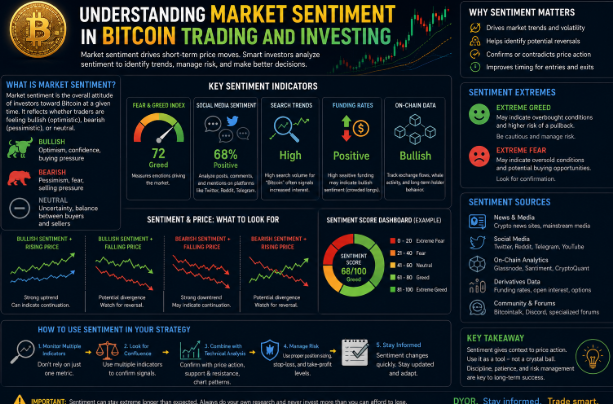
Introduction to Market Sentiment
Market sentiment is a critical concept in the realms of Bitcoin trading and investing. It refers to the overall attitude or mood of market participants towards a particular asset—in this case, Bitcoin. This sentiment is not solely determined by technical indicators or market data; rather, it encompasses the collective emotions and perceptions of investors and traders about the future price movements of Bitcoin. In essence, market sentiment acts as a psychological gauge that shapes the decisions of individuals and institutions within the cryptocurrency market.
Understanding market sentiment is essential for effective Bitcoin trading. Traders often analyze this sentiment to make informed decisions about when to enter or exit positions. Bullish sentiment usually signifies that market participants expect the price of Bitcoin to rise, while bearish sentiment indicates expectations of a price decline. This collective outlook can affect price dynamics significantly, leading to heightened volatility or trends that traders must navigate.
The significance of market sentiment in Bitcoin investing cannot be overstated. Investors often rely on sentiment as an indicator of potential market movements, using it to anticipate shifts in supply and demand. Tools such as sentiment analysis, social media trends, and trading volume can provide insights into the prevailing mood of the market, enabling traders and investors to align their strategies accordingly. By grasping the concept of market sentiment, participants in the Bitcoin arena can better position themselves to leverage opportunities and mitigate risks associated with this increasingly popular digital asset.
The Psychology Behind Market Sentiment
Market sentiment plays a crucial role in the world of Bitcoin trading and investing, significantly influenced by psychological factors. Among these, fear and greed stand out as primary emotions that can dictate market movements. In a typically volatile environment like Bitcoin, the emotional impulses of traders often lead to rapid purchasing or selling decisions based more on psychological triggers than on logical analysis. For instance, during periods of soaring prices, greed can inspire buying frenzies, prompting investors to jump on the bandwagon for fear of missing out on potential gains. Conversely, in moments of steep declines, fear can lead to panic selling, as individuals try to avoid further losses.
Herd behavior is another critical psychological factor that significantly influences market sentiment within Bitcoin. Traders frequently look to others for guidance in uncertain markets, leading to collective decision-making that can amplify price shifts. When a notable trend emerges, such as a dramatic rise or fall in Bitcoin prices, many investors are inclined to imitate the actions of others. This behavior not only impacts their individual investment strategies but can also contribute to significant market fluctuations.
Furthermore, cognitive biases, such as overconfidence and loss aversion, can cloud investors’ judgment, causing them to either downplay risks associated with Bitcoin or hold on too tightly to losing positions. Overconfidence in one’s trading abilities might result in underestimating the volatility of Bitcoin or ignoring market signals that suggest caution. On the other hand, loss aversion leads investors to hesitate when faced with selling loser positions, oftentimes hoping for a recovery that may never materialize.
Understanding these psychological aspects provides valuable insight into market sentiment dynamics. Recognizing how emotions can drive market trends is vital for Bitcoin investors aiming to navigate its unpredictable nature effectively.
Tools and Indicators for Measuring Market Sentiment
In the rapidly evolving world of Bitcoin trading, understanding market sentiment is essential for making informed investment decisions. Several tools and indicators can assist traders in gauging the prevailing sentiment in the market. One prominent method is through social media analysis. Platforms such as Twitter and Reddit serve as hubs for cryptocurrency discussions, where sentiments can be observed through mentions, hashtags, and posts. By monitoring the volume of positive versus negative posts about Bitcoin, traders can gain critical insights into public sentiment, which can significantly affect market movements.
Another important tool is the sentiment index, which aggregates various data points to assign a numerical value reflecting the market’s overall mood. These indices typically analyze factors such as social media chatter, news sentiment, and trading volumes, providing a comprehensive view of market dynamics. For instance, if the sentiment index indicates a bullish outlook, it might suggest that traders are optimistic about Bitcoin’s future performance, thereby influencing their trading strategies.
In conjunction with sentiment indices, trading volumes can also serve as valuable indicators. High trading volumes often signal robust interest in Bitcoin, which can correlate with positive sentiment. Conversely, low volumes may indicate uncertainty or lack of confidence among investors. Analyzing these volumes in relation to price movements can help traders identify potential trends and reversals.
In conclusion, utilizing a combination of social media analysis, sentiment indices, and trading volumes enables investors to better understand market sentiment in Bitcoin trading. Crafting a strategy that incorporates these tools can lead to more informed investment decisions, ultimately improving trading outcomes in this volatile market.
The Role of News and Events in Shaping Sentiment
In the realm of Bitcoin trading and investing, understanding market sentiment is crucial, as it heavily influences price fluctuations. News and events play a significant role in shaping this sentiment, with regulatory announcements, technological advancements, and macroeconomic factors being key drivers behind market reactions. For instance, when a government announces strict regulations on cryptocurrencies, it can create a wave of uncertainty, leading to negative market sentiment and subsequent price declines. Conversely, favorable regulatory news can spur optimism, resulting in price surges.
Technological progress also contributes significantly to market sentiment. Innovations like the implementation of the Lightning Network for faster transactions or improvements in security protocols can have a positive impact on how investors perceive Bitcoin’s future. The announcement of partnerships with major financial institutions, for example, often leads to increased trading volumes and a bullish sentiment amongst traders, as these developments signify growing acceptance and legitimacy within mainstream finance.
Additionally, macroeconomic factors—such as inflation rates, interest rates, and changes in monetary policy—also heavily influence market sentiment. When inflation rates rise, many investors turn to Bitcoin as a hedge against currency devaluation, thereby increasing demand and driving up prices. An example of this was observed during the COVID-19 pandemic when massive fiscal stimulus measures raised concerns about inflation, resulting in a significant appreciation of Bitcoin.
In essence, the interplay between news, events, and market sentiment creates a dynamic environment for Bitcoin trading and investing. Understanding how these elements interact enables investors to make more informed decisions, ultimately enhancing their trading strategies and investment returns.
Analyzing Sentiment Trends
Sentiment analysis plays a vital role in understanding Bitcoin trading and investing. By analyzing historical sentiment trends, investors can gain insights into the emotional states of market participants, which in turn may influence price fluctuations. Various tools and techniques have been developed to assess market sentiment, allowing traders to interpret the mood of the market effectively.
One method of analyzing sentiment involves tracking social media mentions, news articles, and forum discussions surrounding Bitcoin. High volumes of positive or negative sentiment often correlate with market movement. For example, a surge in negative sentiment can foreshadow potential downturns as panic selling may begin to occur. Conversely, accumulating positive sentiment may indicate a bullish trend, as investors express confidence in Bitcoin’s future prospects.
Recognizing patterns in sentiment trends is crucial for anticipating price movements. Historical data can reveal cyclical behavior, where similar sentiment trends have led to comparable price outcomes. By highlighting these patterns, investors can make more informed decisions based on past indicators.
Additionally, sentiment analysis can be enhanced through the utilization of sentiment indices, which aggregate various sentiment measures into a single value. Such indices provide a clearer picture of the overall market sentiment and offer a guideline for trading strategies.
In the ever-evolving landscape of Bitcoin, understanding sentiment trends can be the key to identifying entry and exit points that maximize profit potential. Traders who effectively analyze sentiment trends are better equipped to navigate market volatility and make timely decisions based on the prevailing attitudes of market participants. Continuing to track and interpret these trends can lead to a deeper understanding of how sentiment influences Bitcoin pricing dynamics.
Market Sentiment vs. Market Fundamentals
In the realm of Bitcoin trading and investing, understanding the distinction between market sentiment and market fundamentals is crucial. Market sentiment reflects the overall attitude of investors towards Bitcoin, which can be influenced by news, social media, market trends, and broader economic factors. This emotional and psychological aspect often causes price movements that do not always align with the fundamental aspects of Bitcoin, such as its supply mechanics, blockchain technology, and regulatory environment.
Conversely, market fundamentals focus on the underlying economic variables that impact Bitcoin’s value. This includes its finite supply of 21 million coins, the level of adoption by users and merchants, network security, and the overall financial ecosystems that support cryptocurrencies. For instance, positive developments like increased institutional investment or enhanced regulatory clarity can strengthen the fundamentals and positively affect Bitcoin’s valuation.
However, there are instances when market sentiment deviates significantly from these underlying fundamentals. For example, during periods of exuberance, such as market rallies driven by speculative trading, Bitcoin may reach surges in value that are not justified by its basic financial principles. Similarly, bearish sentiment can lead to price crashes despite favorable fundamentals, influenced by panic selling or negative news cycles. Traders must thus develop a keen sense for discerning when market sentiment may be misleading, allowing them to make informed trading decisions that reconcile these two aspects.
Ultimately, a balanced approach that considers both market sentiment and fundamental analysis is essential for Bitcoin traders and investors. By remaining vigilant to the interplay between these factors, one can enhance their capacity to navigate the volatile landscapes of cryptocurrency trading successfully.
Case Studies: Market Sentiment in Action
Market sentiment plays a critical role in the trading and investing of Bitcoin. Observing particular instances where public perception has dramatically influenced market movements can provide valuable insights for traders and investors alike.
One notable case occurred in December 2017, when Bitcoin reached its all-time highs close to $20,000. This surge can largely be attributed to overwhelmingly positive market sentiment, driven by media coverage and a growing number of retail investors entering the market. The excitement surrounding Bitcoin’s potential to disrupt traditional finance fueled speculative trading, leading to a rapid increase in price.
However, this euphoria was short-lived. By early 2018, a significant downturn began as negative sentiment began to permeate the market. Concerns about regulatory crackdowns, security issues, and the sustainability of Bitcoin’s value, coupled with public skepticism, led to a steep decline in price, ultimately dropping to around $3,000 by December 2018. This shift in market sentiment made it evident that emotions, rather than fundamentals, were driving the price fluctuations.
More recently, in October 2020, Bitcoin experienced another sentiment-driven rally after the announcement of major institutional investments, notably by companies like MicroStrategy and Square. This development sparked bullish sentiment in the market, portraying Bitcoin not only as a speculative asset but also as a legitimate store of value. The buying frenzy propelled Bitcoin’s price to surpass $12,000 and eventually led to its impressive gains in 2021.
These case studies highlight the volatile nature of Bitcoin trading influenced by market sentiment. Understanding how emotions like fear and enthusiasm shape market dynamics can significantly aid traders and investors in making informed decisions.
Strategies for Trading Based on Market Sentiment
Incorporating market sentiment into trading strategies is essential for cryptocurrency investors, especially when dealing with the volatile nature of Bitcoin. Understanding market psychology can provide valuable insights, allowing traders to navigate the complexities of price movements more effectively. Here are several strategies that traders can utilize to harness market sentiment in their trading plans.
Firstly, it is essential to monitor social media platforms and online forums where discussions about Bitcoin take place. Platforms like Twitter and Reddit can serve as real-time indicators of market sentiment. By analyzing the volume and tone of discussions surrounding Bitcoin, traders can gauge bullish or bearish sentiment. This can inform entry and exit points for trades, helping to align positions with the prevailing market mood.
Moreover, sentiment analysis tools offer an efficient way to quantify market feelings. These tools can track sentiment indicators based on news articles, social media posts, and recent price movements. By integrating these insights into trading decisions, traders can enhance their ability to predict market trends. Keeping an eye on sentiment-related news that can sway Bitcoin prices, such as regulatory announcements, can also provide significant advantages.
Risk management in sentiment-driven trading is paramount. Crypto markets can shift rapidly, and decisions based solely on sentiment can expose traders to considerable risk. Thus, it is prudent to utilize stop-loss orders to protect gains during sentiment-driven trades. Setting predefined limits can help mitigate potential losses during unforeseen market reversals. Additionally, diversifying within the cryptocurrency space may help buffer against the inherent risks associated with trading based on market sentiment.
Incorporating these strategies can help traders build a more robust trading plan that acknowledges the influential role of market sentiment, leading to more informed and calculated trading decisions in the volatile landscape of Bitcoin investing.
Conclusion and Future Outlook on Market Sentiment
In summary, understanding market sentiment is crucial for anyone involved in Bitcoin trading and investing. Market sentiment serves as an indicator of the collective attitudes and emotional responses of investors toward the cryptocurrency market. It often influences price movements and can serve as a tool for decision-making. The analysis of sentiment, particularly in the highly volatile Bitcoin market, can provide valuable insights that standard technical and fundamental analysis might overlook.
As we look to the future, the potential for advanced market sentiment analysis tools continues to grow. As technology evolves, data analytics and artificial intelligence are becoming increasingly capable of capturing the nuances of market emotions. Upcoming developments may include sophisticated algorithms that can process vast amounts of social media content, news articles, and other public discourse, thereby providing traders with real-time sentiment data. This could provide unprecedented advantages in understanding short-term price fluctuations.
Moreover, as the global acceptance of Bitcoin increases, market sentiment will likely become even more complex, influenced by a broader range of factors, including regulatory changes, economic indicators, and technological advancements. Investors will need to remain vigilant and adaptable, continuously updating their strategies based on shifting sentiment trends.
Encouragingly, for those keen on navigating the Bitcoin market, actively engaging with sentiment analysis can become an invaluable part of their toolkit. It is crucial for readers to stay informed about market trends and sentiment indicators, encouraging them to seek out diverse perspectives and data sources. Engaging with community forums or platforms that discuss Bitcoin can foster a greater understanding of prevalent sentiment, aiding investors in making more informed decisions. By combining traditional analysis with market sentiment insights, investors may further enhance the potential to optimize their trading strategies and investment outcomes.