





Understanding Portfolio Optimization
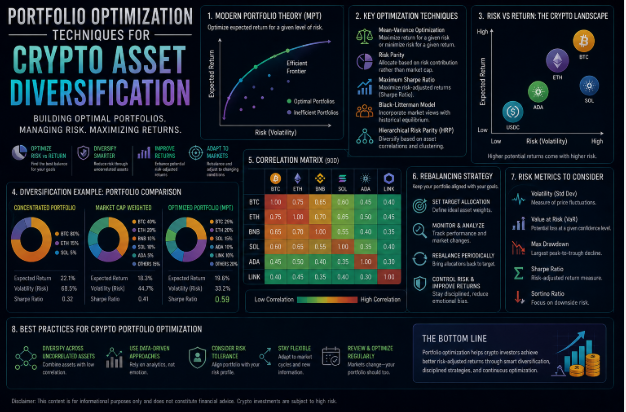
Portfolio optimization is a crucial aspect of investment strategy, particularly in the context of volatile assets such as cryptocurrencies. At its core, the aim of portfolio optimization is to maximize returns while minimizing risk. This process involves analyzing various assets to determine the most effective mix that achieves desired investment goals.
Central to portfolio optimization is the concept of risk versus return. Investors generally seek to achieve the highest possible returns for a given level of risk, or conversely, minimize risk for a given expected return. Understanding this trade-off is vital for making informed investment decisions. A well-optimized portfolio considers both potential risks associated with various assets and their historical performance, allowing for a balanced approach to investing.
Asset allocation plays a significant role in portfolio optimization. It involves distributing investments among different asset categories, such as stocks, bonds, and cryptocurrencies, which helps mitigate risk. The rationale behind asset allocation is that different assets respond differently to market conditions, reducing the impact of volatility associated with any single investment. By diversifying a portfolio across various assets, investors can lower the overall risk and increase the chances of achieving stable returns.
Moreover, diversification is essential in reducing portfolio risk, particularly in the cryptocurrency market, known for its price swings and unpredictable behavior. By investing in a range of crypto assets, from established coins like Bitcoin to emerging altcoins, investors can create a more resilient portfolio. This strategy not only spreads risk but also allows investors to capitalize on different market trends and opportunities.
The Importance of Diversification in Crypto Investments
Diversification plays a pivotal role in mitigating risk and enhancing potential returns within the realm of cryptocurrency investments. The crypto market is notoriously volatile, characterized by rapid price fluctuations and uncertainty. In such an unpredictable landscape, a diversified portfolio can serve as a safety net, helping investors to reduce their exposure to any single asset’s performance.
Various types of crypto assets are available for investment, including established coins like Bitcoin and Ethereum, as well as a plethora of altcoins and tokens. Each of these assets comes with its unique risk profile and market behavior. By spreading investments across different cryptocurrencies, investors can take advantage of various growth potential while minimizing the overall risk. For example, while one asset may experience a dramatic downturn due to market shifts or regulatory news, another may thrive concurrently, thus cushioning the impact on the investor’s portfolio.
Furthermore, diversification fosters resilience against unforeseen market events. The crypto industry is evolving, with new projects and technologies emerging regularly. By holding a diversified array of assets, investors can capture opportunities from innovative trends while avoiding overexposure to any specific sector. This strategic allocation can not only curtail risk but may also enhance long-term returns as different assets perform variably over time.
In essence, a diversified crypto investment portfolio acts as a buffer against the inherent risks of the market. It empowers investors to navigate the complexities of cryptocurrency investing, ensuring that their overall investment strategy is robust against fluctuations while increasing the likelihood of attaining satisfactory returns.
Identifying Crypto Asset Classes for Diversification
In the ever-evolving landscape of cryptocurrency, understanding the various asset classes is fundamental for effective portfolio optimization. This knowledge aids investors in making informed decisions regarding asset selection for diversification purposes. The primary categories of crypto assets include cryptocurrencies, tokens, stablecoins, and altcoins, each exhibiting unique characteristics.
Cryptocurrencies are the most recognized form of digital assets, with Bitcoin and Ethereum being prime examples. They operate on blockchain technology and are primarily utilized as a medium of exchange or store of value. Their value is predominantly influenced by market sentiment, adoption trends, and macroeconomic factors. Investors should note that while cryptocurrencies can provide significant returns, they also come with high volatility levels, which can affect diversification strategies.
Tokens, in contrast, are digital assets that often represent assets or utilities on specific platforms. For instance, utility tokens are integral for accessing services within their ecosystems, while security tokens can represent ownership in real-world assets. Tokens can behave differently compared to cryptocurrencies due to their dependence on the performance and management of their underlying platforms. Investors might find that including tokens in their portfolio can offer advantages, particularly in terms of exposure to innovative projects.
Stablecoins are designed to minimize volatility by pegging their value to stable assets, such as fiat currencies or commodities. They serve as a safe haven during market downturns, providing liquidity and helping investors to manage risks effectively. Including stablecoins in a crypto portfolio can enhance diversification, as they typically maintain price stability regardless of market fluctuations.
Lastly, altcoins comprise any coins other than Bitcoin. This category encompasses a wide array of cryptocurrencies that may significantly deviate in performance compared to Bitcoin. By analyzing the underlying technology, use cases, and market performance of altcoins, investors can further refine their diversification strategies.
Risk Assessment in Crypto Investments
Understanding the risks associated with cryptocurrency investments is critical for investors seeking optimal portfolio diversification. In an evolving market characterized by volatility and unprecedented growth, assessing risk becomes essential. One of the primary methodologies employed in this evaluation is the Sharpe ratio, which quantifies the return of an asset relative to its risk. The formula for the Sharpe ratio involves subtracting the risk-free rate from the asset’s return, then dividing by the asset’s standard deviation. This risk-adjusted metric allows investors to compare the performance of cryptocurrencies against various benchmarks.
In addition to the Sharpe ratio, investors often analyze volatility measures to evaluate the price fluctuations of crypto assets. High volatility can indicate both opportunities for high returns and increased risk exposure. Investors should monitor the historical price movements of cryptocurrencies, assessing how they react to market conditions and macroeconomic factors. Understanding these patterns enables better predictions of potential future performance, aiding in the construction of a well-balanced portfolio.
Market sentiment is another crucial factor in risk assessment. Cryptocurrency prices can be profoundly affected by public perception and social media influence. Monitoring trends in investor sentiment can provide valuable insights into market dynamics and help identify potential risks before they manifest as significant price shifts. Sentiment analysis tools, coupled with traditional metrics, can enhance an investor’s ability to navigate the complex landscape of cryptocurrency investing.
In conclusion, incorporating methodologies such as the Sharpe ratio, volatility measures, and market sentiment analysis offers a comprehensive approach to risk assessment in crypto investments. By understanding these elements, investors can make informed decisions and work towards achieving optimal asset diversification in their portfolios.
Techniques for Building a Diversified Crypto Portfolio
Building a diversified crypto portfolio is a fundamental strategy aimed at mitigating risk while capitalizing on the growth potential inherent in digital assets. To achieve this, investors can employ several techniques, each with unique advantages and challenges.
One common method is equal weighting, where an investor allocates the same amount of capital to each asset in the portfolio. This approach prevents overexposure to any single cryptocurrency, promoting a balanced risk distribution. However, equal weighting can also lead to volatility, especially if less established altcoins contribute significantly to market fluctuations.
Another prevalent technique is market capitalization weighting. In this strategy, allocation is based on the market capitalization of each cryptocurrency: larger-cap coins receive a more substantial share of the portfolio. This method aligns the portfolio with the overall market performance, potentially leading to greater stability. Yet, this technique has its drawbacks as well; it may increase exposure to dominant players, potentially disregarding promising emerging assets.
Furthermore, investors may choose between active and passive management strategies. Active management involves frequently adjusting the portfolio based on market trends and asset performance, which can lead to higher returns but also incurs increased transaction costs and requires a keen market awareness. Conversely, passive management entails a buy-and-hold approach, maintaining the portfolio with minimal changes. This method caters to long-term growth but may miss out on short-term profit opportunities.
Ultimately, the choice among these techniques should be guided by the investor’s risk tolerance, market outlook, and investment goals. Combining multiple strategies might also be an effective way to enhance the overall robustness and performance of a diversified crypto portfolio.
Utilizing Modern Portfolio Theory (MPT) in Crypto
Modern Portfolio Theory (MPT) is a cornerstone of investment strategy that seeks to maximize expected returns based on a specific level of risk through the use of diversification. Originally formulated by Harry Markowitz in the 1950s, MPT emphasizes the importance of an investor holding a diversified portfolio to mitigate the variability of returns while aiming for a desired return. In the context of the rapidly evolving cryptocurrency market, applying MPT principles can provide investors with a robust framework for optimizing their portfolios.
In the realm of cryptocurrencies, where volatility is prominent, MPT offers valuable insights on how to manage risk effectively. By considering various crypto assets, investors can build a portfolio that balances the potential high returns of certain cryptocurrencies—such as Bitcoin or Ethereum—against the risks associated with their price fluctuations. MPT postulates that the correlation between different assets plays a critical role in portfolio optimization. Thus, selecting cryptocurrencies with low or negative correlations can lead to an overall reduction in portfolio risk.
Investors can leverage MPT by assessing the expected returns and risks associated with various cryptocurrencies. This involves calculating the historical returns, the standard deviation of those returns (as a measure of risk), and the correlation among the selected assets. Hence, creating an efficient frontier—a graphical representation of the optimal portfolios—allows investors to visualize the risk-return trade-off and make informed decisions about asset allocation.
In essence, employing Modern Portfolio Theory in the crypto space empowers investors to establish a well-structured portfolio that not only aims for superior returns but also reduces potential downside risk. The strategic use of MPT can indeed enhance the overall investment experience in a landscape characterized by unpredictability and rapid changes.
Tools and Platforms for Crypto Portfolio Management
Effective management of a cryptocurrency portfolio requires the use of specialized tools and platforms designed to optimize asset performance. These resources not only help in tracking individual asset values but also provide insightful analytics for informed decision-making. When selecting a tool for crypto portfolio management, there are several key features to consider that can significantly enhance your investment strategy.
One crucial feature is performance tracking, which should provide real-time updates of your portfolio’s value across different exchanges and wallets. This allows investors to monitor their assets closely and react promptly to price fluctuations. Many platforms also offer customizable dashboards that can display pertinent metrics, such as daily gains and losses, overall ROI, and historical performance, thereby aiding in comprehensive analysis.
Another essential aspect is the inclusion of risk assessment tools. The volatile nature of cryptocurrency markets necessitates robust risk management strategies. Platforms that incorporate analytics for assessing market risk, volatility measures, and correlation among assets can help investors understand their exposure and make necessary adjustments to their portfolios. Additionally, some tools allow users to simulate various scenarios, providing insights into potential future performance based on market trends.
Furthermore, effective asset allocation functionalities should be a priority. Look for tools that offer recommendations for diversifying your portfolio based on your risk tolerance and investment goals. These features can suggest optimal asset allocations by analyzing current market conditions and historical data, thereby enabling investors to make data-driven decisions.
In summary, utilizing the right combination of tools and platforms for crypto portfolio management can significantly enhance the effectiveness of asset diversification and optimization. By focusing on performance tracking, risk assessment, and asset allocation, investors can navigate the complexities of the cryptocurrency market more efficiently.
Rebalancing Your Crypto Portfolio
Rebalancing is a crucial aspect of managing a cryptocurrency portfolio, ensuring that it aligns with an individual’s investment goals and risk tolerance. The process involves adjusting the proportions of different cryptocurrencies within a portfolio to maintain a pre-defined asset allocation. Regular rebalancing mitigates risks associated with market volatility, allowing investors to adapt to price fluctuations and keep their investments within desired risk parameters.
The timing of rebalancing can vary depending on several factors, including market trends, the level of volatility, and shifts in an investor’s objectives. A common approach is to rebalance periodically — for instance, quarterly or semi-annually. However, rebalancing can also be triggered by significant market movements or when an asset class deviates from its target percentage by a predetermined threshold, such as 5% or 10%. This proactive strategy enables investors to sell high-performing assets and purchase underperforming ones, which is particularly relevant in the dynamic crypto landscape.
Additionally, understanding the underlying factors driving market changes is essential for effective rebalancing. This knowledge allows investors to anticipate potential shifts and align their portfolios accordingly. By evaluating market conditions, investor sentiment, and technological advancements within the crypto space, one can make informed decisions on whether to adjust their allocations. Moreover, during downturns in the crypto market, rebalancing can present an opportunity for long-term investors to accumulate undervalued assets, enhancing the potential for future returns.
In conclusion, the practice of rebalancing crypto portfolios is vital for maintaining the desired asset allocation and managing risks. By performing regular assessments and adjustments in response to market changes, investors can take advantage of growth opportunities while adhering to their overall investment strategy.
Future Trends in Crypto Portfolio Optimization
The landscape of cryptocurrency investment is evolving rapidly, with emerging trends in portfolio optimization techniques playing a pivotal role in enhancing asset diversification. One significant trend is the integration of artificial intelligence (AI) in the analysis and decision-making processes. AI tools can process vast amounts of data with precision, providing investors with insights that were previously unattainable. Through algorithms that learn from historical market trends, AI can help forecast price movements, evaluate optimal entry and exit points, and suggest asset allocations tailored to an individual’s risk tolerance and investment goals.
In addition to AI, decentralized finance (DeFi) is reshaping how investors approach portfolio diversification. DeFi platforms allow users to participate in lending, borrowing, and yield farming, all without the need for traditional intermediaries. This democratization of finance enables investors to optimize their portfolios by earning returns through various innovative mechanisms. For instance, yield farming enables users to stake their crypto assets and earn interest, thus enhancing the potential for growth while maintaining exposure to multiple assets.
As market dynamics become increasingly complex, crypto investors must be adaptable and agile. Flexibility in strategies will be essential, allowing for the reallocation of assets in response to market changes. Utilizing advanced portfolio management tools, investors can track their holdings and performance in real-time, ensuring that they remain informed and ready to adjust their strategies. Moreover, the rise of tokenized assets and fractional ownership will enable wider participation in diverse asset classes, further promoting optimal portfolio diversification.
In conclusion, the future of crypto portfolio optimization is likely to be influenced significantly by technological advancements and innovative financial instruments. By embracing AI, leveraging DeFi, and adapting strategies to the ever-changing market landscape, investors can better navigate the complexities of crypto asset diversification.